
The C-Suite Dilemma: Is AI Paying Off—or Just Paying Out?
India's enterprise sector is investing heavily in AI transformation across sectors like banking, logistics, pharma, and automotive. But a pressing boardroom question remains:
The Key Question
"What are we actually gaining from our AI investments?"
Traditional ROI metrics – like cost savings or productivity gains – don't capture the full impact of AI. For example, a 1.5% improvement in conversion might seem small, but for a consumer bank with 15 million customers, it could mean an additional ₹400 crore in revenue.
To address this, Indian enterprises need a multidimensional, context-aware AI ROI framework that reflects the country's business realities: cost sensitivity, regulatory flux, talent gaps, multilingual operations, and heterogeneous tech landscapes.
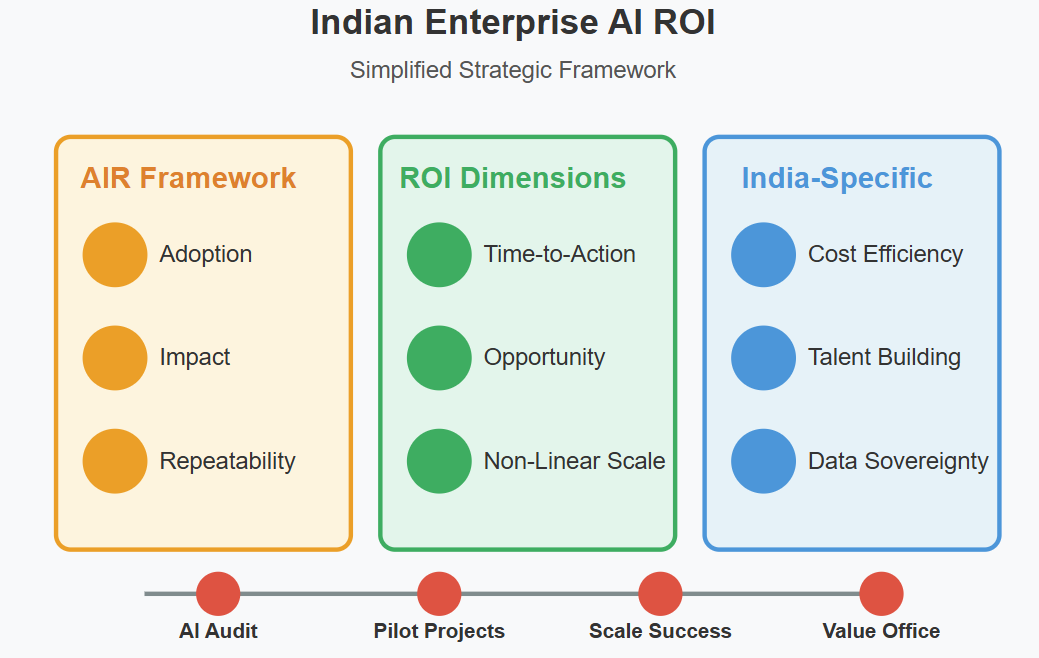
Strategic Framework for AI ROI
The visual model accompanying this blog consolidates three critical elements of AI ROI for Indian enterprises:
ROI Dimensions: Key areas where AI unlocks measurable gains
- Time-to-Action: Speed of decision-making and execution
- Opportunity: Capturing revenue previously missed due to latency or inefficiency
- Non-Linear Scale: Scaling impact without linear resource growth
India-Specific Drivers: Operational realities and market conditions
- Cost Efficiency: Low-capex, modular deployments
- Talent Building: Workforce readiness and capability creation
- Data Sovereignty: Navigating India's evolving regulatory landscape
Each of these dimensions aligns with a practical sequence of actions illustrated in the diagram:
This phased roadmap reinforces how enterprises can move from intent to impact in a structured, strategic manner.
India-Specific Considerations
Cost-Efficient Implementation: AI doesn't have to mean high CapEx. Many Indian enterprises are using open-source models, cloud credits, and modular deployments. For example, a textile exporter in Tiruppur implemented a demand prediction model using only ₹12 lakh in total investment.
Talent and Capability Building: AI ROI is unsustainable without workforce alignment. Organizations must:
- Upskill business analysts on prompt engineering
- Re-skill legacy IT staff to manage AI workflows
- Partner with ed-tech platforms for pipeline hiring
Multilingual and Cultural Context: A southern state-run health system increased beneficiary satisfaction by 38% by deploying a Tamil and Telugu-native AI assistant. Culturally aware AI significantly boosts adoption and trust.
Legacy Integration Strategy: Enterprises like Indian Railways and PSUs operate with mixed tech maturity. AI ROI must include:
- Middleware costs
- API bridging for legacy systems
- Incremental automation over rip-and-replace
Regulatory Alignment: India's upcoming Digital India Act and DPDP regime require AI systems to be auditable, transparent, and explainable. Compliance is no longer a cost – it's part of AI ROI.
SME-Relevant Scaling: AI is no longer the domain of IT giants. A 50-cr turnover auto component SME used vision AI to reduce defect rates by 11%, improving EBITDA by 1.3%.
Data Sovereignty Impact: Enterprises must plan for the cost of storing and processing data within Indian borders. For one BFSI major, the localization mandate increased infra costs by 22%, which needs to be offset through efficiency gains.
Competitive Benchmarking: The Race Has Begun
Industry Impact
Indian enterprises that delay AI ROI tracking risk being outpaced by leaner, AI-native disruptors.
Executive Roadmap: 3 / 6 / 9 Month View
Next 3 Months:
- Conduct an AI capability audit (infra, talent, adoption)
- Identify 2-3 pilot areas with measurable impact
- Establish AI Value Office (cross-functional task force)
Next 6 Months:
- Implement AIR framework to benchmark AI portfolio
- Train 10-20 mid-level leaders on ROI-centric thinking
- Integrate AI metrics into digital board reports
Next 9 Months:
- Scale 2 successful pilots across units
- Capture external signals (analyst reports, customer feedback, NPS)
- Publish internal AI ROI dashboard for transparency and alignment
Conclusion: The Real ROI of AI is Strategic Fitness
Indian enterprises face a defining moment. The ROI of AI is no longer just a metric – it's a proxy for how ready you are to compete in an intelligent economy.
Whether you're a sector leader or an emerging SME, AI investments must yield tangible, trackable returns—not someday, but now.
It's time to evolve your ROI lens. The future belongs to the bold, the adaptive, and the intelligently measured.
Interested in building your AI ROI scorecard?
Schedule a strategy session with Pragyametrics' AI advisory team. Let's redefine what value looks like—on Indian terms.
Schedule a Strategy Session